TOC
Rapid supply and demand growth
Solar and wind are the fastest-growing sources of electricity generation in history and have the potential to deliver at least 30% of global power generation in 2030. Simultaneously, rapid electrification (e.g., vehicles, appliances, and industrial processes) has emerged as the primary strategy for achieving global net-zero emissions by mid-century.
These developments on both the demand and supply sides have the potential to deeply and disruptively transform global energy systems. However, this progress won’t materialize without rapid modernization of power grid infrastructure–the bridge between renewable supply and electrified demand.
To unlock the necessary pace of decarbonization, both the “hardware” of the power system (i.e., poles, wires, transformers, sensors, meters) and the “software” (i.e., the policies, regulations and remuneration programs) must be addressed.
Grids are falling behind
Currently, grid modernization efforts are falling behind the pace of the clean energy transition. Building and upgrading transmission lines is slow and expensive, while permitting, financing, and supply chain barriers create long delays. Outdated planning tools and institutional inertia keep utilities focused on fossil-based solutions, making it harder to integrate renewables, storage, and demand-side flexibility. The result is grid bottlenecks: interconnection delays, grid congestion, clean energy that is wasted instead of delivered, and mounting costs that stall decarbonization and undermine reliability.
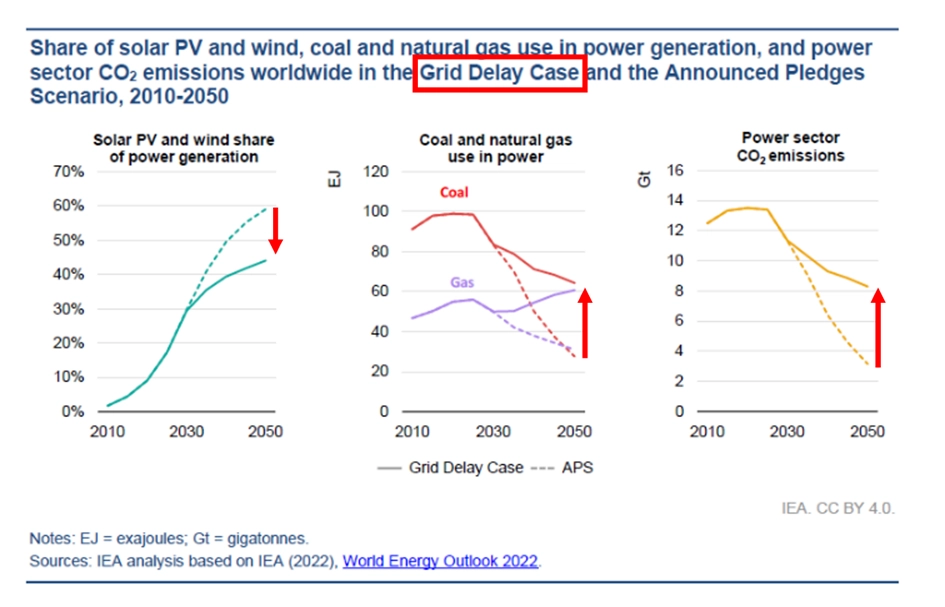
Grid bottlenecks limit the integration of solar and wind with electrified demand, leading to increased use of fossil fuels, and ultimately to higher emissions. As shown in Figure 1 below (right side), if current delays in grid development persist, power sector emissions in 2050 could be nearly three times higher than planned—posing a serious threat to climate targets and undermining the credibility of the energy transition.
Early warning signs of how outdated grid infrastructure and operational practices can slow down or halt transformation efforts are already visible. For example, in Germany and the Netherlands, grid infrastructure is failing to keep up with the transition’s needs (especially at the distribution level), resulting in increasing delays – or even outright refusals by authorities – for the connection of new renewable energy sources and new electricity demand (e.g., from electric vehicle charging infrastructure). In Brazil and Vietnam, the lack of alignment between renewable auctions/support schemes and grid planning led to a similar failure of the grid to keep up with the resulting explosion in the deployment of distributed renewable energy sources. Among other consequences, this has led to the need for significant renewable curtailment. In both cases, much could have been prevented with more proactive grid planning, state-of-the-art operation practices and improved interconnection processes. The recent blackout in Spain and Portugal is another example of operational practices failing to keep up with new operational realities: as outdated regulations prohibited solar and wind from providing the system services they are capable of, and conventional power plants contracted for this purpose failed to provide those services, a local voltage issue escalated into a full system collapse.
The consequences of delayed grids
Such incidents highlight the risks of continued delays in grid modernization, escalating emissions and eroding public trust. Policymakers must navigate difficult trade-offs around affordability, reliability, and environmental preservation, while minimizing impacts on landscapes and communities. Addressing these challenges requires decisive and coordinated policy action to prevent grid bottlenecks from becoming a major obstacle to achieving climate and energy goals. The figure below from the IEA shows the impact of delays in grid modernization and development on the deployment of renewables (reduced increase), the generation of electricity from fossil sources (reduced decrease), and ultimately power sector emissions (reduced decrease).
How the Grids Policy Toolkit can help
The grid policy toolkit is designed to provide policymakers and regulators and other decisionmakers with actionable resources for modernizing power grids to integrate renewable energy and flexible electrification. It offers tailored best practices and recommendations to address key challenges across various policy and regulatory dimensions. The toolkit features user-friendly interactive modules, compelling visuals, and dynamic graphs, delivered through an interactive website, downloadable documents, and derivative materials such as fact sheets and case studies.
The toolkit highlights that it is both feasible and essential to simultaneously and rapidly (1) build renewables, (2) electrify demand, and (3) expand and operate the grid to enable it all while minimizing unintended consequences of moving at speed. It emphasizes the importance of simultaneously coordinating supply- and demand-side transformations. Indeed, if electricity demand grows faster than clean energy and the requisite power grid, or if grid planning and operational practices do not evolve sufficiently quickly to guarantee continued reliability in this new power system context, incumbents will continue to argue that fossil-based systems are needed. And if the power grid is not modernized and expanded rapidly enough to connect new sources of electrified demand, it could dampen the pace of electrification. The toolkit offers practical strategies to ensure grids are designed, expanded, and operated in lockstep with both renewable deployment and end-use electrification, so that the transition to clean energy does not slow down, become significantly more expensive, or face greater political challenges.
Read more about the topic
Add further keywords to the heading. Use a maximum of 12 words to ensure clarity and readability.